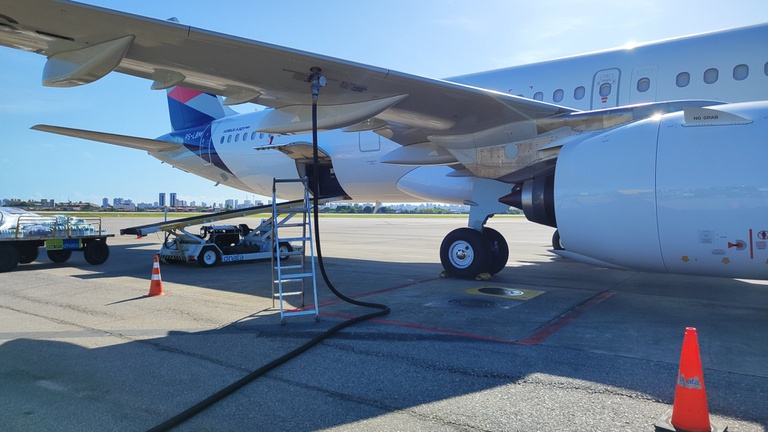
The National Monetary Council (CMN) approved this week a resolution establishing conditions for the granting of up to R$ 1 billion in financing destined for working capital of Brazilian airlines. The measure is part of a set of actions announced by the Ministry of Ports and Airports (MPor) to support the aviation sector in the face of rising aviation fuel (Jet A) prices, one of the main costs for these companies.
The resolution provides for operations with a term of up to six months for payment, a rate equivalent to 100% of the CDI and a financing limit corresponding to up to 1.6% of the gross revenue for 2025 of each company, capped at R$ 330 million. The funds will be administered by Banco do Brasil, with credit risk fully assumed by the Union.
According to the Minister of Ports and Airports, Tomé Franca, the measure follows the logic of actions adopted in exceptional moments, such as those implemented during the floods in Rio Grande do Sul, and seeks to preserve the continuity of essential services. "Since the credit will have a Union guarantee, it was necessary to establish criteria of safety and financial responsibility for the benefited companies. Even in an emergency measure, it is important to preserve balance and responsibility in sector operations," the minister stated.
According to the National Secretary of Civil Aviation at MPor, Daniel Longo, the approval represents another step in the federal government's effort to preserve air connectivity and ensure stability to the sector. "We are working to offer short-term conditions that help companies navigate a moment of strong cost pressure. This resolution is a concrete measure to provide liquidity to the airlines and preserve the country's air network," he stated.


Other measures
In addition to the emergency credit line, the package presented by MPor includes other measures to support the sector. Among them are the extension of the payment term for air navigation fees, discussions on tax mechanisms related to aviation fuel, and actions to expand regulatory predictability and reduce operational costs for the sector.
The measures have been debated by MPor, in coordination with other federal government bodies, airlines and sector entities, in view of the increase in operational costs observed in recent months, especially due to the rise in international oil prices and exchange rate fluctuations.
```