
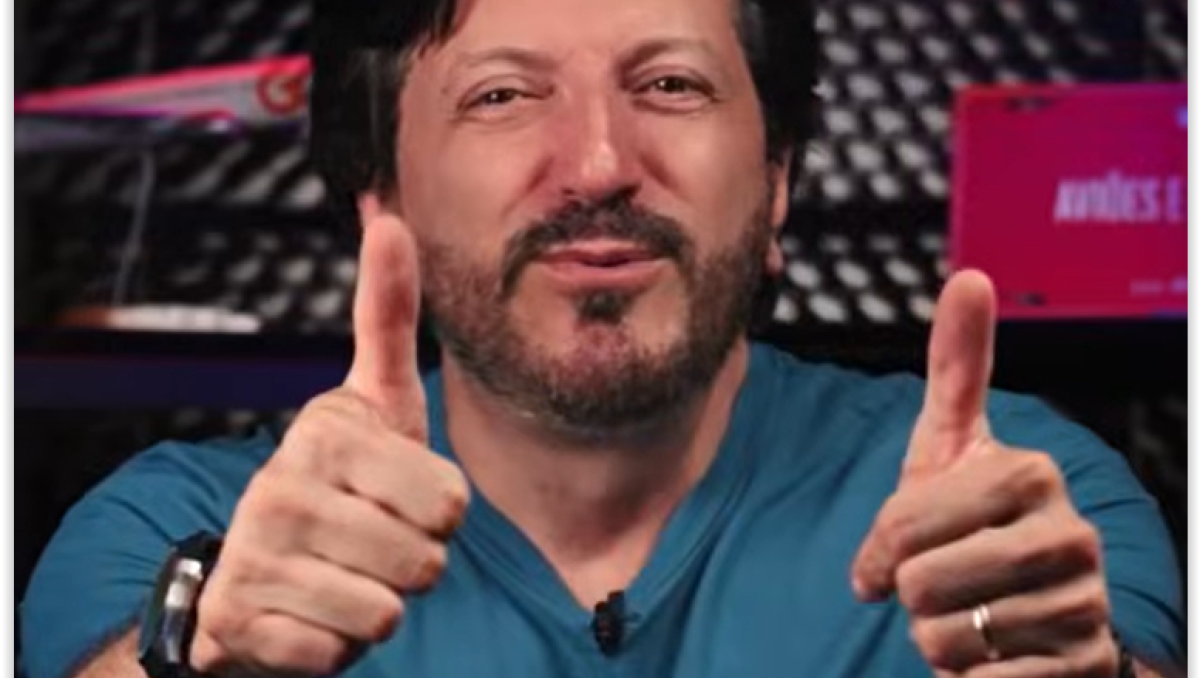
LITO SOUSA
When I was a child, my father made a deal with me: every time I achieved a monthly school grade of 9.0 or higher, he would give me a book.
I built a respectable collection that included authors such as Mark Twain, Victor Hugo, and Jules Verne, among others. They were simple editions, but from an early age they taught me that content is far more important than the aesthetics or luxury of the binding—much like it is with some human beings.
One of those books, "The Conquest of Space" (1968), by Elliot Dooley, together with some TV series I had been watching since I was three years old—Jet Jackson, Thunderbirds, Fireball XL5, and Steve Canyon—made me fall in love with aviation.
When I started learning the national anthems at school, I, who already had jets and rockets in my imagination, grew frustrated with the Brazilian Air Force Anthem, whose refrain goes: "Contact! Comrades! To the wind, commanding, let us launch the roar of the spinning propeller." I considered it anachronistic. Today, with the success of the EMB-314 "Super Tucano," I recognize I was wrong.
I drew airplanes, molded them with broomsticks and scraps of wood. I even made a fleet of paper airplanes in various shapes. They didn't need to glide. With a small electric motor I had received, I tried to make an airplane using an oil can as a fuselage. The most I achieved was cutting myself, rather badly too. I also tried to make a rocket using alcohol as fuel. I nearly set fire to my father's tool shed. I managed to put out the fire before it spread.
I already had a vocation for engineering, but I thought it better to change "airs," that is, specializations.
This passion for aviation makes me always watch films on the subject, and the same goes for space travel and associated science fiction.
I became so enchanted by it that I even dreamed of getting my pilot's license before my driver's license. To this day I like to sing the jingles of Varig ("Brazilian stars, in the blue sky...") and Vasp ("Attention! You, with that card in your hand...").
However, I only flew on an airplane at age 25, and right away on a transatlantic flight, thanks to a scholarship to study in Europe.
Unfortunately, the TV series about aviation became increasingly rare, as rarefied as the air at high altitudes. Cable TV and, especially, YouTube gave me the chance to find some of the films and series I loved so much, and the associated algorithms began suggesting productions on the subject.
It was thus that I had the immense pleasure of discovering Lito Sousa and his "Airplanes and Music." He explained things that did not appear in the films: how they worked, the importance of each component, reasons for aircraft accidents, and so on—a technical approach made in a pleasant and objective manner, even when addressing the most complex subjects.


Lito was not an "influencer," a word I dislike, but a seasoned professor, so respected that he was invited to other programs, leaving his interviewers just as captivated as I was.
He commanded his subject naturally, vividly, engagingly, with genuine knowledge, like anyone who loves what they do and strives to know ever more. His programs were appetizing conversations in which he seemed to anticipate the questions of those watching.
It was a pleasure to watch his programs! In fact, I will continue to watch them whenever possible.
That is why the news of his rare illness shocked many, including me. A terrible disease alternated moments of some, little, hope with the certainty that death was imminent and inescapable.
Lito's farewell was of immense sadness, because, although he said he was prepared for his final "flight," I believe no one ever truly is, even when they wish it, for whatever reason.
Airplanes imitated birds and opened the way to space, which, contrary to what they claim in the opening of "Star Trek," is not necessarily the final frontier. There are still other dimensions to be explored.
``` ```htmlLito probably departed for one of them. A pity that he won't be able to tell us, in the way we learned to enjoy and admire, how it is and how it works.
For all that he lived and bequeathed, he surely took flight, as the Brazilian Air Force anthem says: "To pray to the Southern Cross".
Adilson Luiz Gonçalves
Writer, Engineer, University Researcher and member of the Santos Academy of Letters
```