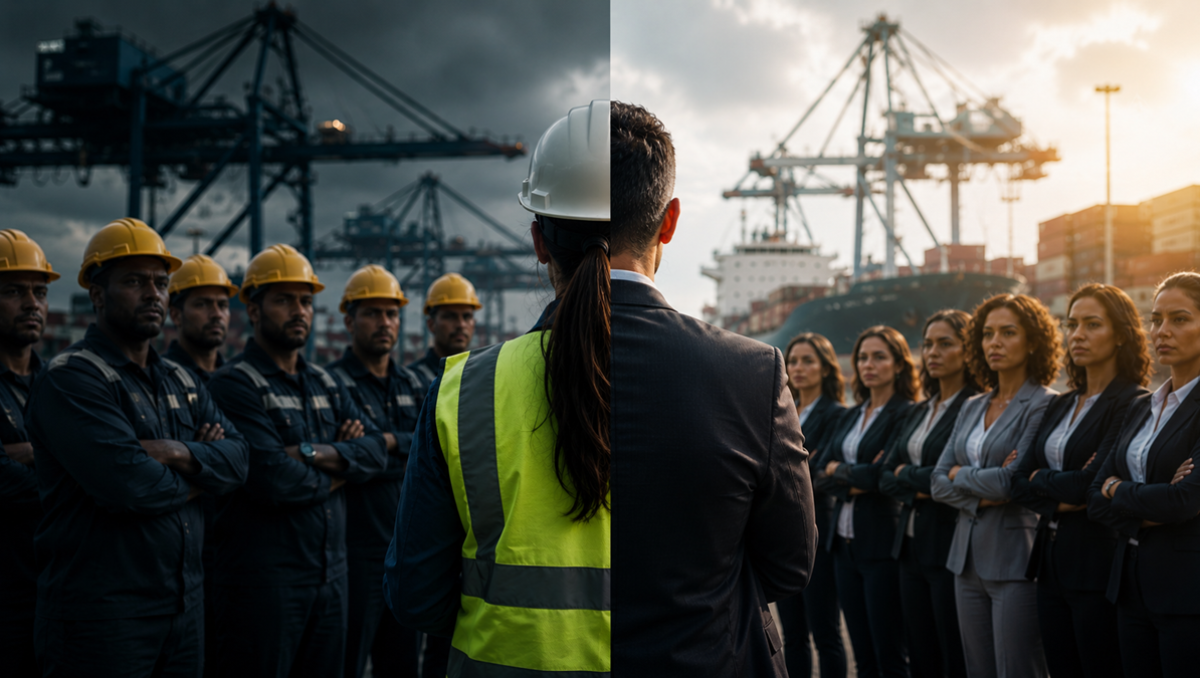
While They Discuss Gender, Operations Remain Halted!
Modern rivalry is not born merely from differences. It is born from the constant need to transform them into primary identity. In the port environment, this has become a silent paradox.
Inclusion is necessary. It always has been. For decades, entire groups were excluded from spaces of leadership, decision-making, and recognition. To ignore this would be to deny social history itself. The problem does not lie in inclusion itself, but in the way it has come to be presented. In many discourses, the valorization of the individual has ceased to happen on the basis of competence, vision, character, or capacity for transformation, and has instead begun to happen first because of the label that person carries.
Society began to constantly hear that someone occupies a certain space "despite being a woman", "despite being a man", "despite having a social disadvantage", "despite coming from the periphery" or "despite being different". Even when the intention is positive, the effect can be contradictory: the narrative of difference becomes larger than the person and the purpose themselves.
And perhaps that is precisely where representativeness loses its force.
There exists a silent difference between inclusion and the narrative convenience they try to sell us. The first seeks to open space. The second seeks to build discourse. And in recent years, many companies have learned that narrative sells more than results.
In the port sector, this is beginning to become increasingly evident.
Historically, ports have always been environments in which productivity, psychological resilience, swift decision-making, and heavy operations defined who remained standing. It was never an environment driven by beautiful LinkedIn speeches, collaborative coffee sessions, or meetings about corporate sensitivity. A ship does not reduce queue time through an institutional campaign. A railcar does not unload because of a hashtag. And a truck with a ton of cargo sitting idle continues to generate losses, regardless of the gender stamped on the ID badge.
Productivity became a secondary detail in the face of the institutional aesthetics of inclusion.
But the scenario has changed.
It is no longer a matter of discussing who delivers the best operational result. It is a matter of discussing who better composes the company's photograph in the annual report. After all, there seems to exist a modern corporate logic in which an efficient operator is worth less than a good publication about diversity at eight in the morning.
And, of course, questioning this immediately generates discomfort. Because they have built a moral shield around the topic. Any minimally critical reflection already receives the automatic stamp of resistance to progress.
But there is a question that few seem willing to answer transparently:
Is inclusion being built to generate opportunity… or to feed a socially profitable corporate narrative?
Because there is a very fine line between opening space and transforming people into institutional symbols.
The problem does not lie in women occupying historically male sectors. This is natural, necessary, and irreversible. The problem begins when part of the discourse tries to sell the idea of automatic moral superiority. As if competence had a gender. As if productivity could be measured by visual representation.
In the port sector, especially, reality tends to be less ideological and more brutal: poor operations generate queues, delays, costs, and pressure. The crane does not differentiate discourse. The train does not wait for narrative. And the ship continues to charge demurrage, regardless of how many motivational posts were published that week.
Perhaps that is why there exists so much silent discomfort within operations. Many professionals perceive that the modern company has come to value the message it transmits more than the environment it actually builds. An invisible competition is created, in which groups begin to compete for legitimacy while merit, discreetly, slips out the back door.
In the end, the feeling that remains is strange.
Inclusion should bring people together. But in many cases, the current discourse seems to depend precisely on the constant maintenance of differences. After all, if one day everyone were seen solely as equally capable professionals, perhaps some narratives would lose their corporate utility.
```

Today, in many corporate environments, there seems to exist an almost desperate need to prove something to society. It is not enough to hire competent people; one must transform this into a campaign. Thus emerges a silent model of "They for everyone… and everyone for whom, exactly?", in which, curiously, the pursuit of equality begins to assume a tone of symbolic dispute.
And the most curious thing perhaps is the following: nobody talks anymore about ability alone. The entire debate revolves around who represents what.
Something curious is happening, especially in operational sectors: it seems that producing has become merely an administrative detail. What matters now is to look socially correct in the photograph of the annual report.
In the port sector, this becomes almost poetic.
The ship awaiting berthing. The queue growing. The operator under pressure. The client demanding productivity. But hold on… before solving the operation, we need to ensure that the institutional narrative is aligned with this month's discourse.
Because today it is not enough to work well. One must represent something.
And perhaps that is the greatest silent problem of the new corporate culture: they have turned competence into a secondary agenda. The focus is no longer "who delivers results," but "who best symbolizes the company's message."
Of course, nobody says this openly. The discourse always comes wrapped in pretty words, motivational workshops, and carefully calculated hashtags. Everything very human in PowerPoint. But in the operation… the wagon remains stopped just the same.
And no, the criticism is not about inclusion. Inclusion is necessary. It always will be. The problem begins when it stops being an opportunity and becomes institutional marketing with a badge.
A quasi-theatrical need has been created to divide people into permanent groups: men, women, white, Black. As if nobody could simply be competent without carrying a corporate flag hanging on their back.
The most ironic thing is that sectors like the port industry never had patience for romanticization. The port is brutally honest. If the operation works, everyone wins. If it doesn't work, the bill arrives quickly and it doesn't come asking what the social identity of the team was on that shift.
But there is a new logic attempting to rewrite this. A kind of "They for Them", in which some companies seem to believe that visual representation automatically substitutes operational efficiency.
As if productivity could be compensated by discourse.
As if the crane had developed social consciousness.
And perhaps it is precisely this excess that begins to wear down the cause itself. Because when everything becomes narrative, even legitimate causes begin to look artificial. People stop seeing inclusion as natural evolution and begin to see it as a carefully rehearsed institutional strategy.
Because there is an important difference between acknowledging inequalities and transforming identities into boundaries.
The curious thing is that the greatest transformations in history rarely happened when someone tried to prove superiority over another group. They happened when society understood that human capacity does not belong to gender, color, or origin.
True inclusion perhaps does not lie in daily reminders of who we are biologically or socially, but in creating spaces where this stops being the most important characteristic in the room. After all, competence has no gender. Intelligence has no color. Character has no social class.
And perhaps this explains the silent discomfort that nobody likes to admit publicly: many companies say they want equality, but they continue feeding divisions because rivalry also generates engagement, positioning… and corporate applause.
In the end, the ordinary worker perceives something simple: while part of leadership discusses symbolism in air-conditioned rooms, those in operations continue to be evaluated by the only metric that has never gone out of fashion: results.