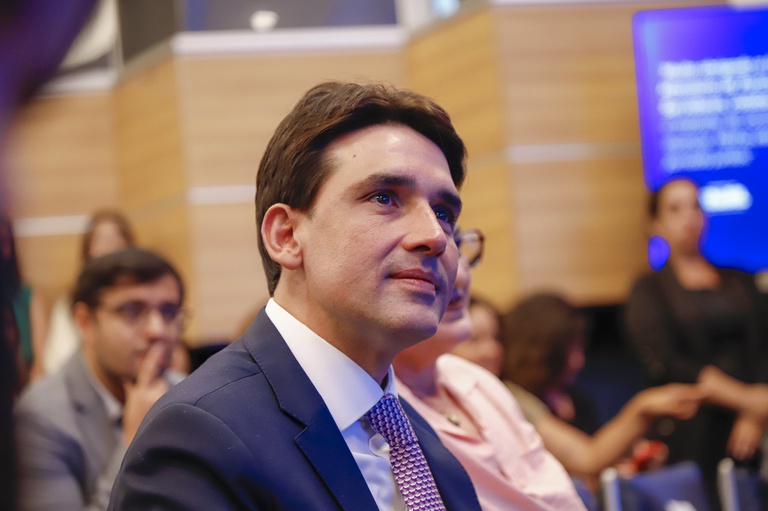
After two and a half years at the helm of the Ministry of Ports and Airports, between September 2023 and March 2026, Minister Silvio Costa Filho stepped down from office on Tuesday (31st), leaving behind a legacy of management marked by a period of modernization and strategic investments that fueled Brazil's economic and social development. With a focus on connectivity and inclusion, the ministry recreated by the Brazilian Government has achieved remarkable results, consolidating a new cycle of growth for both sectors.
One of the pillars of the management was attracting investments to the modal sectors. "During the period we headed the ministry, we pursued resources for investment in Brazil's infrastructure, both present and future. Through this, we modernized the country and prepared it for a new growth cycle," said Minister Silvio Costa Filho.
The actions of the MPor had direct impact on people's lives, generating immediate jobs during construction and operations, as well as permanent and skilled positions. The experience of travelers was also renewed, with improvements benefiting nearly 130 million passengers recorded recently, such as the construction of new jet bridges and larger, more modern terminals.
Inclusion
Another pillar of Minister Silvio Costa Filho's management at the Ministry of Ports and Airports was a commitment to social inclusion and the humanization of services, transforming terminals into more welcoming and safe spaces for all citizens.
Among the initiatives, the Passenger Care Program for Autism Spectrum Disorder (ASD) implemented 22 multisensory rooms in airports, surpassing targets and offering a differentiated environment for neurodivergent passengers. Ground and in-flight teams were trained to ensure more humanized service, consolidating the vision that air transport is an essential service that must be prepared to welcome the diversity of the Brazilian population.
The Ministry also intensified actions to protect and respect women, with the campaigns "Harassment Doesn't Take Off" and "Harassment Doesn't Take Off, Neither Does Femicide". These initiatives established clear protocols for prevention and reporting of sexual harassment and gender-based violence, using the high flow of terminal traffic to raise societal awareness.
Additionally, 74 full scholarships were offered for Aircraft Maintenance Mechanic courses, aimed at low-income youth and women, which confirmed the MPor's commitment to professional training and democratizing access to careers in civil aviation.
The agenda also included animal welfare, with the launch of the Air Transport Plan for Animals (PATA), which standardizes and enhances safety in the transport of pets.
Connectivity
The strategic management of the Ministry of Ports and Airports extended to national connectivity. The modernization of Congonhas Airport, for example, consolidated it as one of Latin America's leading hubs. Growth expansion to interior regions was prioritized, bringing cutting-edge infrastructure to states such as Minas Gerais, Mato Grosso do Sul, and Pará, connecting productive areas to major markets and generating wealth away from capital cities.


Port sector records
The port sector under Costa Filho's management also reached a moment of renewal and major advances. In 2025, total cargo handling reached 1.34 billion tons, a growth of 3.25% compared to the previous year. This capacity gain was fundamental to meet the increased demand for commodities, with emphasis on petroleum (+74%), soybeans (+73.9%), and beef (+70.5%) in exports.
Brazilian ports were instrumental in allowing the country to achieve, for the third consecutive year, a trade surplus, with the trade flow reaching US$ 629 billion in 2025 and a surplus of US$ 68.2 billion, the third largest in history.
"The numbers show that Brazil is experiencing a new context in terms of logistics. It is no coincidence that the three largest surpluses in our history have occurred in the last three years. This proves that port infrastructure has become a means of competitiveness," stressed the minister.
Shipbuilding industry
Silvio Costa Filho's management also stood out for strengthening the shipbuilding industry. The Merchant Marine Fund (FMM) was key, with R$ 7.2 billion contracted in 2025 for 151 works, and a forecast of R$ 34 billion in new approvals for 2026.
The concessions and auction policy also impacted the sector. In 2025, the Ministry held 21 auctions of port and aviation projects, with investments of R$ 11 billion. For 2026, 40 auctions are scheduled, including 18 ports, 21 airports, and 1 waterway, with expectations of more than US$ 10 billion in private investments.
Legacy
The legacy left by Minister Silvio Costa Filho at the Ministry of Ports and Airports is one of growth, modernization, and generation of opportunities. The records achieved in the port and airport sectors, the attraction of investments, the creation of jobs, and the promotion of strategic industries confirm that the commitment of President Lula's government to sustainable development and Brazil's competitiveness on the world stage has been put into practice.
Special Communication Affairs Office
Ministry of Ports and Airports