A silent transformation is beginning to gain ground on the map of international maritime transport. China is expanding the use of the Northern Sea Route (NSR), a corridor that crosses Arctic waters along the Russian coast and allows connecting Asian and European ports in approximately half the time required by some traditional maritime routes.
Following an operation carried out in 2025, Chinese Sea Legend Shipping increased its bet on the corridor and launched regular seasonal scheduling between Ningbo-Zhoushan, in China, and Felixstowe, in the United Kingdom.
For the 2026 navigation season, eight weekly voyages between August and October have been scheduled, representing an important advance in the attempt to transform the Arctic into a more predictable commercial corridor for containerized cargo.
China and Europe in about 20 days
The main appeal lies in the time factor.
A voyage between Ningbo-Zhoushan and Felixstowe through the Arctic can be completed in approximately 18 to 21 days, depending on navigation conditions.
By the traditional route through the Suez Canal, the transit can exceed 40 days. Via the Cape of Good Hope, it can exceed 50 days.
The difference places the Arctic route in a strategic position mainly for high-value-added cargo and merchandise that depend on shorter logistics cycles.
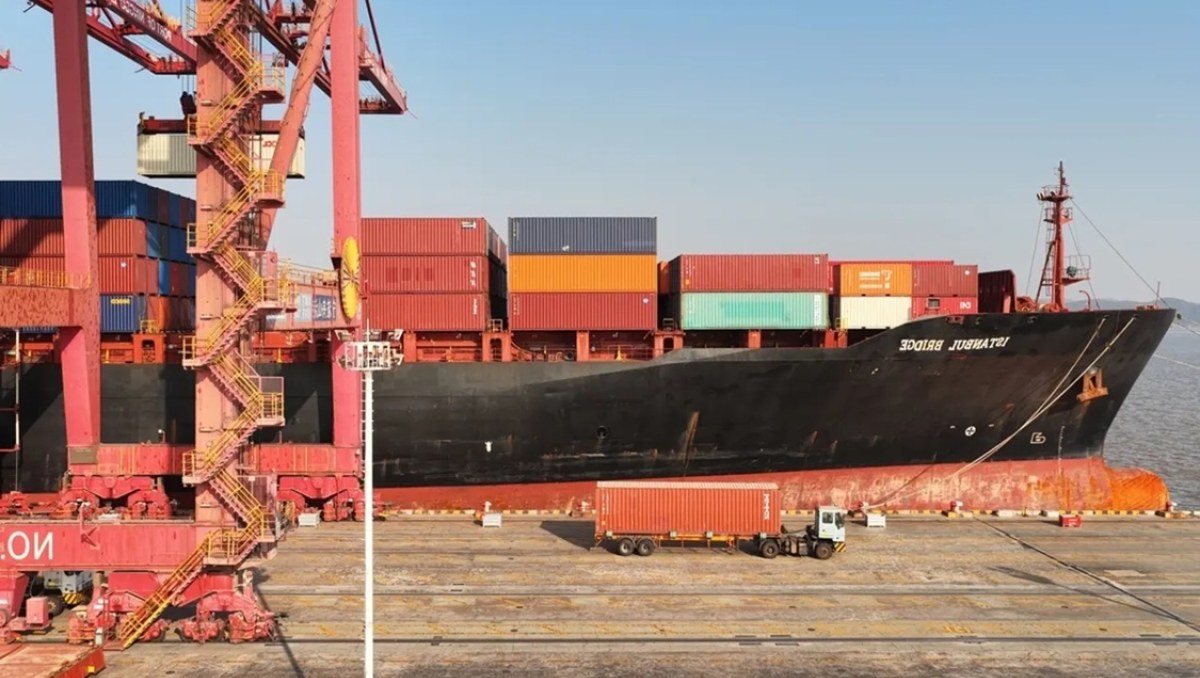
In September 2025, the container ship Istanbul Bridge completed one of the pioneering voyages of the service. The vessel departed from Ningbo-Zhoushan and arrived at Felixstowe in approximately 20 days, demonstrating in practice the possibility of significant transit time reduction.
From experiment to scheduled service
The main shift is happening now.
What began with an experimental voyage is advancing toward a model with scheduled departures during the annual Arctic navigation window.
In August 2026, the Dubai Tower, with approximate capacity for 1,700 TEUs, opened the new season of service.
The strategy calls for consecutive departures during the months when ice conditions permit greater operational safety.
This regularity is fundamental to winning over shippers. In container maritime transport, offering a shorter route is not enough: companies need predictability, frequency, space availability, and integration with land-based logistics chains.
A new path outside Suez
The expansion is also occurring at a time of growing concern with so-called maritime chokepoints, strategic passage points capable of affecting a large portion of world trade when facing conflicts or disruptions.
The traditional maritime connection between Asia and Europe relies heavily on the Suez Canal and access via the Red Sea.
The Northern Sea Route offers an alternative that avoids these critical points and considerably reduces the distance traveled.
For this reason, the Chinese project has been associated with the so-called "Polar Silk Road", Beijing's strategy to expand logistics and commercial alternatives between Asia and European markets.
Russia holds strategic position
Despite Chinese prominence, expansion of this route depends directly on Russia.
Much of the Northern Sea Route follows Russia's extensive Arctic coast, giving Moscow a central role in infrastructure, authorization of operations, and navigation support.
Commercial traffic through the corridor is also growing.


Projections indicate that total traffic on the Northern Sea Route could exceed 40 million tons in 2026, establishing a new record.
Bilateral transport between Russia and China on the route alone exceeded 5 million tons in the first half of this year.
Moscow and Beijing have set the goal of reaching 20 million tons of bilateral cargo by 2030 through the Arctic corridor.
Arctic is still far from replacing Suez
Despite the progress, it would be premature to consider the route a substitute for the Suez Canal.
There are important limitations.
``` ```htmlNavigation remains strongly seasonal and dependent on climatic conditions and ice concentration. There are also challenges involving maritime insurance, availability of suitable vessels, search and rescue infrastructure, and compliance with specific requirements for operations in polar regions.
Moreover, the location of the route in waters close to Russia adds a relevant geopolitical layer in light of international sanctions applied to the country.
Major international shipowners remain cautious about the Arctic.
Environmental concern is also significant. An accident involving fuel or hazardous cargo in polar waters can present consequences far more difficult to control than occurrences in regions with extensive port infrastructure and emergency response capabilities.
A corridor that the maritime industry is beginning to observe
The growth of the Chinese route does not mean that thousands of container ships will leave Suez heading for the Arctic.
But the advance from an experimental voyage to a service with weekly departures during the navigation season changes the dimension of the discussion.
China is beginning to commercially test a third relevant alternative for its maritime connections with Europe: beyond the Suez Canal and navigation via the Cape of Good Hope, there now emerges a corridor via the planet's far north.
If the service can demonstrate regularity, safety and economic viability over the coming years, the Northern Maritime Route could cease to be a curiosity of polar navigation and occupy effective space in the planning of global supply chains.
For ports, shipowners and logistics operators, therefore, the central point may not be to ask whether the Arctic will replace Suez.
The question becomes another:
how much of trade between Asia and Europe could migrate to the Arctic in the coming years?
Jornal Portuário
The safest port of information.