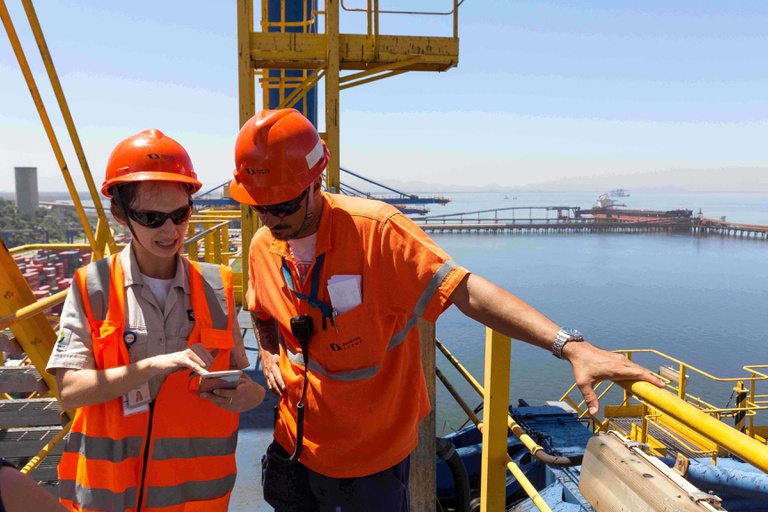
Historically seen as male-dominated environments, Brazil's port and airport sectors are undergoing transformation over the years. The Ministry of Ports and Airports (MPor) has been acting on two fronts to accelerate this change: the recognition of good corporate practices and the execution of direct awareness campaigns aimed at the general public. The objective is to ensure safety, equity and respect for women, both in logistics operations and in passenger terminals.
In the waterway sector, the ministry has mapped and recognized, through its sustainability awards, companies and port authorities that treat gender diversity as an institutional management policy. Practical results can already be seen from north to south across the country.
The Santos Port Authority (APS), for example, stood out with the creation of the Women's Leadership Development Program, which opened 80 positions for female employees, in addition to updating its manual for tackling harassment and discrimination. In Santa Catarina, the Port of Itapoá promoted awareness-raising actions against domestic violence during "Purple August" (Agosto Lilás), providing information about the Maria da Penha Law and the local program "Women in Our Neighborhood".
Wage equity and the occupation of leadership positions also gained rigorous metrics. Ultracargo, a company operating in liquid bulk logistics, set a target of maintaining at least 35% women and Black people in leadership positions. The Pecém Industrial and Port Complex (CIPP), in Ceará, won the State Government's Gender Equity Seal and implemented an indicator to actively monitor wage parity.
Similar inclusion and affirmative action initiatives were also awarded and recognized in companies Cargill and Vports, which reported wage transparency and the absence of harassment complaints without investigation. In the Northeast, the Port of Suape mobilized the "Diverse Working Group" to carry out seven campaigns focused on gender and racial equity following the National Calendar of Equity, Diversity and Inclusion.
Fighting violence takes to the skies


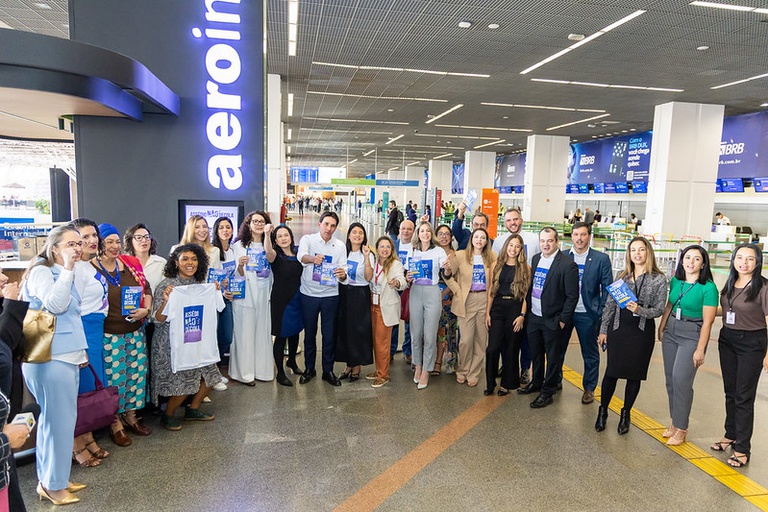
While at the ports the focus has been on changing organizational and operational culture, at airports the strategy encompasses the millions of women who transit through the country. MPor launched the second phase of its main educational initiative in the aviation sector: the campaign "Harassment doesn't take off, Femicide doesn't either" (Assédio não decola, Feminicídio também não).
Presented in its new stage at Congonhas Airport (SP), the mobilization is a partnership with the National Civil Aviation Agency (Anac) and the Brazilian Association of Airport Concessionaires (ABR). The focus is to use the high flow of passengers to disseminate preventive information, display educational videos and widely publicize reporting channels, such as the 180 Hotline.
The central message is that fighting violence against women is not only a women's issue, but a responsibility of society as a whole. Transforming structures of power and coexistence is ongoing work, as stated by the Ministry's Deputy Executive Secretary, Thairyne Oliveira: "we must always work so that women reach decision-making spaces and have their voices heard in these places, a behavior reflects in society by showing that it is possible to have autonomy and build a country with more equality and respect for women", she declares.
With these integrated actions, the Ministry of Ports and Airports demonstrates that the modernization of national infrastructure goes far beyond works and concessions. It necessarily involves ensuring that women can work, lead and travel with dignity and safety.
Source: https://www.gov.br/portos-e-aeroportos/pt-br/assuntos/noticias/2026/03/ministerio-de-portos-e-aeroportos-consolida-acoes-de-protagonismo-feminino-e-de-combate-a-violencia-no-setor