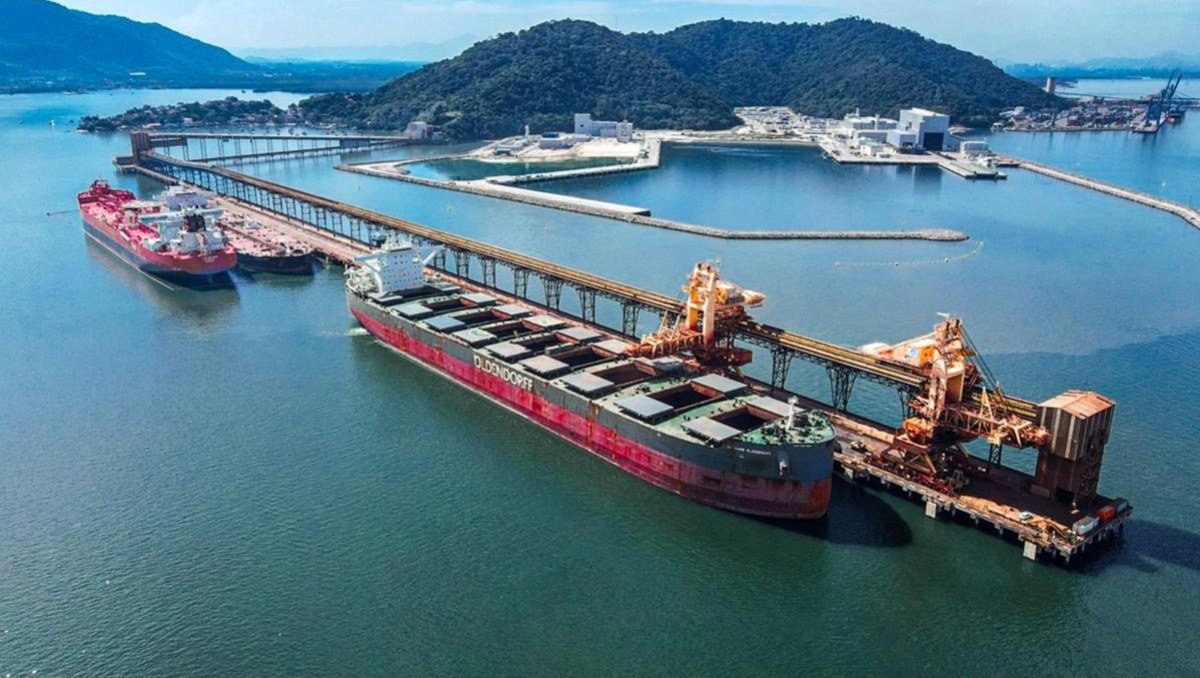
The interest of Global Infrastructure Partners (GIP) in Porto Sudeste may represent more than an isolated movement in the Brazilian port sector. Controlled by BlackRock, one of the world's largest asset managers, GIP evaluates infrastructure opportunities and, according to information circulating in the market, the move involving the terminal located in Itaguaí (RJ) could open space for an expansion strategy reaching other logistics assets.
In this scenario, MRS Logística emerges as one of the main points of attention.
The possible rapprochement between the assets gains relevance due to the complementarity existing between railway and port. Porto Sudeste plays a strategic role in the movement of iron ore, while MRS operates an extensive railway network connecting major producing regions and logistics hubs to the Southeast port system.
A possible integration or rapprochement between these structures could create a logistics platform with greater control over different stages of mineral cargo transport, from the arrival of ore at the railway system to its shipment to the international market.
Railway and port on the same board
The interest of major investors in infrastructure assets is not new in Brazil. Ports, railways and cargo terminals possess characteristics that can make them strategic for long-term investors, especially when there is potential for operational complementarity.
In the case of Porto Sudeste, its location in Sepetiba Bay places the terminal in an area of great importance for the export of iron ore.
MRS, in turn, has direct connection with producing regions and important port facilities in Rio de Janeiro and São Paulo.
This characteristic means that any movement involving both assets is closely watched by the logistics and mining market.
What is at stake
A possible strategy involving Porto Sudeste and MRS would not merely mean an expansion of participation in infrastructure assets.
The main potential would lie in integration of the logistics chain.
The greater the coordination between railway and port terminal, the greater the capacity to plan cargo flows, reduce interference, increase the predictability of train arrivals and improve the utilization of available infrastructure.
For high-volume cargo such as iron ore, seemingly small operational gains can represent significant impacts when considered across millions of tons moved annually.
It is precisely this scale that makes railway and port assets strategic for major international investors.
BlackRock expands presence in infrastructure
GIP was acquired by BlackRock in 2024, in a transaction that reinforced the global manager's presence in the infrastructure segment.


The strategy expands BlackRock's access to assets considered essential for the economy, including energy, transportation and logistics infrastructure.
In Brazil, this move gains importance given the need for investments in railways, ports and export corridors.
The expansion of Brazilian logistics capacity depends, to a large extent, on improving the connection between producing areas and ports used for exports.
Could MRS be the next chapter?
The possibility of MRS entering the radar of a strategy related to Porto Sudeste needs to be treated, at this moment, with caution.
This is not to say that a transaction involving the railway company is defined. What exists is a strategic hypothesis observed by the market, based on the complementarity between the assets.
MRS holds a relevant position in the Brazilian railway system, especially in the transport of ore and in the connection of important producing regions to Southeast ports.
Therefore, any movement involving its corporate structure or its main assets could produce effects that would extend beyond the company itself.
A possible new logistics design
Should an integration strategy advance, the result could be a new design for part of the logistics corridor used by the mining sector.
```Port, railway and storage infrastructure would come to be viewed not merely as independent businesses, but as components of the same chain.
This model is of particular interest to infrastructure investors because it allows them to seek efficiency gains at different points in the system.
For Brazil, the discussion is also relevant. The competitiveness of mineral exports depends not only on production capacity, but on the efficiency with which cargo can travel the route between the mine and the ship.
In this context, Southeast Port may be at the center of a movement that goes far beyond a single terminal.
The market is now watching the next steps taken by GIP and BlackRock and, above all, whether interest in the port asset can evolve into a broader strategy involving the railway infrastructure that feeds the major export corridors of southeast Brazil.
If this rapprochement truly advances, the discussion will cease to be merely about who controls a terminal and will come to involve who will have greater influence over one of the country's main export logistics chains.