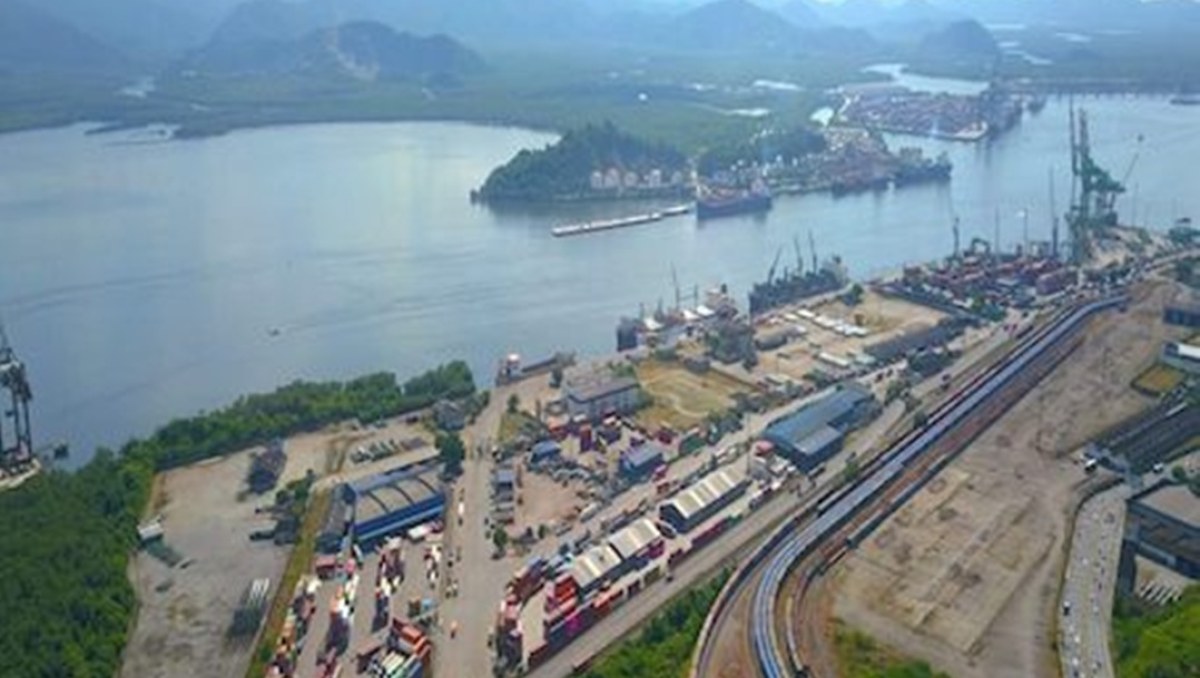
The dispute for Tecon Santos 10 has gained a piece capable of altering not only who will be able to control the future mega-terminal, but also the configuration of one of the main container terminals currently in operation at Santos Port.
The Office of the General Superintendent of the Administrative Council for Economic Defense (Cade) approved an operation involving MSC and Maersk that establishes a mechanism to unwind the partnership maintained by the two companies in Brasil Terminal Portuário (BTP), should one of them win the future Tecon Santos 10.
Currently, MSC and Maersk equally share control of BTP.
The mechanism analyzed by Cade establishes an anticipated solution to one of the main competitive concerns surrounding the new terminal: preventing the winner from remaining simultaneously at Santos 10 and in the partnership that controls another major container terminal in the Santos complex.
Two giants and two terminals
In practice, the agreement creates two possible paths.
If MSC wins Tecon Santos 10, its 50% stake in BTP may be transferred to Maersk. In that scenario, the Danish company would come to hold BTP entirely, while MSC would move on to the new terminal.
If the opposite occurs and Maersk wins Santos 10, MSC may retain its stake from the former partnership and assume 100% of BTP.
This structure is relevant because it creates in advance an exit path for either of the two companies.
Until then, one of the major uncertainties was precisely how to allow the participation of shipowners already vertically integrated at Santos Port without creating an even greater concentration of port infrastructure.
The agreement attempts to address part of that equation.
Cade dismisses ICTSI concerns
The operation did not pass without contestation.
ICTSI, a Philippine group operating in Brazil, raised concerns related to the competitive effects of the structure proposed by the two companies.
Among the points raised was the possibility that the reorganization would not result in effective deconcentration, considering that MSC and Maersk would continue to be present in the Santos market—one eventually at Tecon Santos 10 and the other controlling BTP.
Concerns were also raised regarding the possibility of coordination between the companies.
The Office of the General Superintendent of Cade, however, deemed the elements presented insufficient to support these concerns and approved the operation.
The problem of vertical integration remains at the center of debate
The discussion goes beyond the names MSC and Maersk.
Tecon Santos 10 has placed at the center of Brazilian port policy a debate that should accompany future concessions: to what extent should shipowners also control terminals at strategic ports?
Vertical integration is not a Brazilian exclusive.
Major shipping groups have been increasing their participation worldwide in terminals, land logistics, storage and other segments of the supply chain.
From a business perspective, there is clear logic: the greater the control over the logistics chain, the greater the ability to integrate services and manage costs.
From a competitive standpoint, however, other questions arise.
Can a shipowner that also controls port infrastructure direct its own cargo to its terminals? Will independent operators have equivalent competitive conditions? And how to ensure non-discriminatory access to infrastructure?
These are some of the questions that have transformed Santos 10 into much more than simply another port lease.
Santos 10 may reshape the container map
The future terminal will be built in the Saboó region and will have approximately 622 thousand square meters, four berths and capacity to add more than 3 million TEUs annually to Santos Port.
By its dimensions, the enterprise should rank among the country's largest container terminals.


This means the winner will not simply be acquiring another facility.
It will be conquering a strategic position in Brazil's largest port complex precisely at a moment of growing containerization and increasing size of vessels serving the Brazilian coast.
```That is why every change in the rules triggers such significant movement among operators, shipowners, regulatory agencies, and competition authorities.
Cade approval does not mean a guaranteed slot in the auction
There is, however, an important difference.
Cade's approval of the corporate reorganization does not represent definitive authorization for MSC and Maersk to participate in the auction.
The agency analyzed the competitive effects of the agreement involving BTP's corporate structure.
The conditions of the future tender continue to depend on the modeling conducted by the Federal Government and the corresponding regulatory proceedings.
And that is precisely where another chapter begins.
The rules initially discussed for Santos 10 provided for restrictions on the participation of companies already established at the Port of Santos. Subsequently, the Federal Government began working with alternatives that would allow greater participation, accompanied by mechanisms designed to reduce concentration risks.
This change will still need to go through institutional steps before the definitive publication of the notice.
Whoever wins Santos 10 may lose BTP — but gain much more
From a strategic perspective, the agreement creates an uncommon situation.
MSC and Maersk will be able to enter the future tender knowing that winning Santos 10 could mean abandoning their participation in an established terminal.
But there is an obvious counterpart.
The winner will be able to assume a new enterprise of large scale, designed to meet the future growth of container traffic at the Port of Santos.
Meanwhile, the company that does not win Santos 10 may exit the competition with another extremely relevant asset: 100% of BTP.
Therefore, in certain scenarios, the result of the auction could produce two simultaneous transformations in the Santos complex.
On one side, a new major operator emerges in Saboó.
On the other, the fifty-fifty partnership that today controls BTP disappears.
The board has changed, but the game has not yet begun
Cade's approval removes an important corporate uncertainty, but it is far from ending the Tecon Santos 10 saga.
There are still regulatory decisions and definitions about the final model of the tender.
What can already be observed is that the future terminal has ceased to represent merely a physical expansion of the Port of Santos.
It may reorganize the very distribution of power among some of the world's largest shipping and port operating groups present in Brazil.
That is why, when the auction finally takes place, what will be at stake is not only an area of 622 thousand square meters in Saboó.
A strategic position will be at stake in the future of container traffic at Latin America's largest port.
And, depending on who wins, the result could also determine who will be left in sole control of BTP.