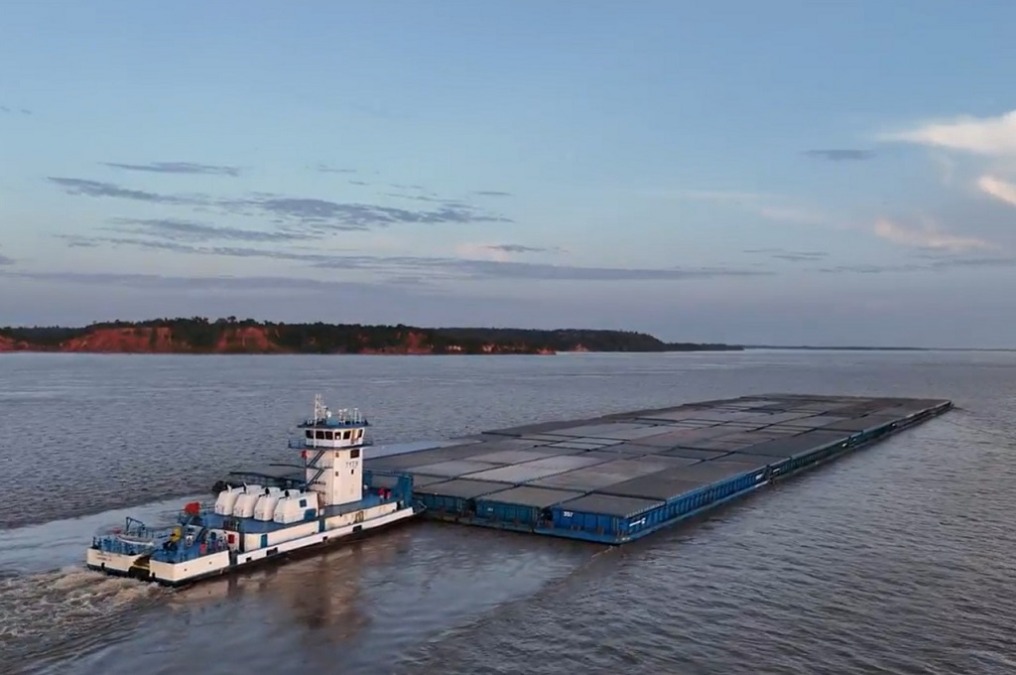
The Bertolini group marks one year of operating one of Brazil's largest river convoys for grain transport by cargo volume, consolidating its position as a benchmark in logistics integration between highways and inland waterways. Currently operating in the Estreitos region, in Pará, the fleet transports 62.5 thousand tons of grain per voyage between Miritituba and Vila do Conde, underscoring the strategic importance of the Northern Arc for domestic agribusiness.
According to the company, the convoy's operational capacity is approximately 25% higher than similar operations currently on the market. This gain made it possible to expand the composition from 20 to 30 barges, significantly increasing inland waterway transport efficiency.
Named Bertolini CL, the convoy is equipped with four Mitsubishi Marine 12-cylinder engines, each delivering 1,180 hp. The vessel was built at the Beconal shipyard, which belongs to the Bertolini group itself, and has approximately 450 tons of gross tonnage.
The logistical impact of the operation is significant. Each voyage carried out by the convoy is equivalent to removing approximately 1,250 trucks from Brazilian highways, helping to reduce heavy traffic, operational costs, and emissions associated with land transport.
The cargo transported consists mainly of soybeans produced in the Brazilian cerrado. The grain travels through inland waterway corridors on the southern bank of the Amazon River to strategic terminals located in Itacoatiara, Santarém, Porto Velho, and Belém, from where it is subsequently shipped to international markets.


For Bertolini group's industrial director, Flávio Silveira, the project represents a milestone in the evolution of national logistics.
"It is one of the most robust examples of road-river logistics integration growth in Brazil, a logistics model that has been gaining prominence, after all it reduces costs, increases operational efficiency, and decreases environmental impacts," he stressed.
The project also received recognition from Mitsubishi Marine, Bertolini's partner since 2006. According to Rodrigo Teixeira, maritime business leader at the company, the engines used in the convoy offer ease of installation, maintenance simplicity, and high operational reliability.
"This is a historic moment for inland waterway transport in Brazil. Through the partnership, we are redefining efficiency and performance standards in the sector," Teixeira said.
The expansion of inland waterway logistics has been considered one of the main alternatives for increasing the competitiveness of Brazilian exports, especially in grain shipments through the Northern Arc, reducing dependence on road transport and expanding cargo handling capacity toward international markets.