
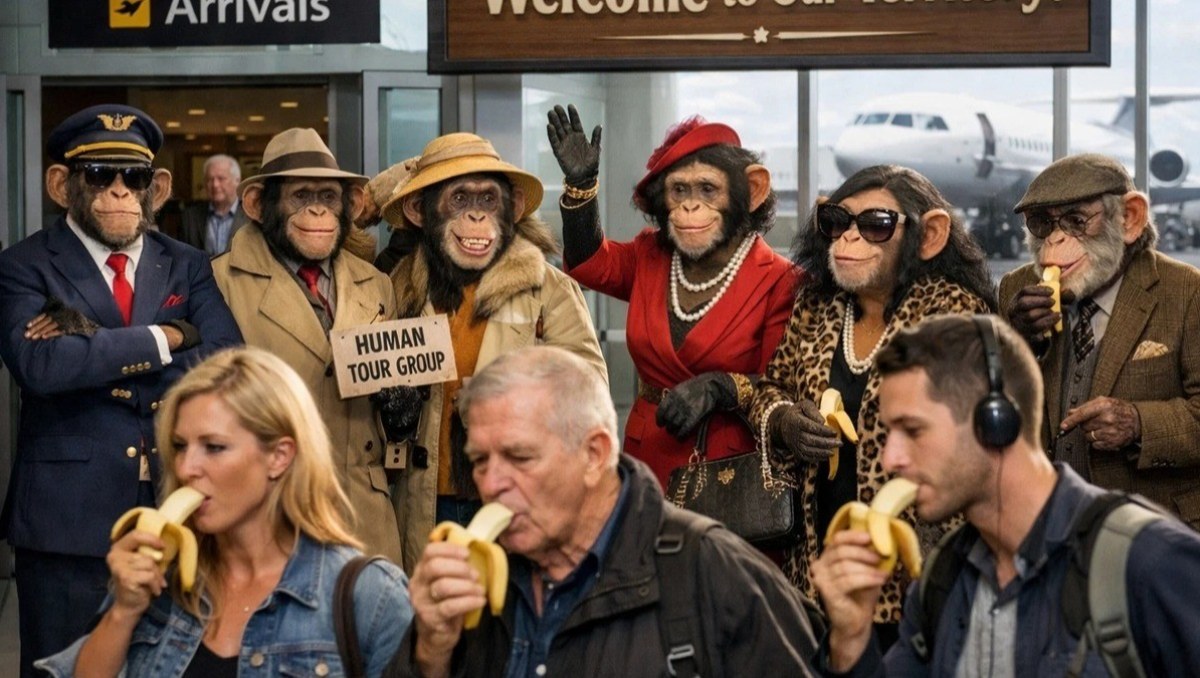
Many people want to discover their ancestry, but few remember their African heritage. An ironic article about descent, identity, and the curious modern quest for citizenship.
Happy reading!
In recent years, it has become almost a national sport in Brazil to discover some lost European great-great-grandfather in the family tree. Whenever a Portuguese, Italian, or Spanish surname appears, the question immediately arises: "Can I get citizenship out of this?" The interest, of course, is not exactly cultural. It's bureaucratic. The ultimate goal is usually a European passport.
Suddenly, many people who never showed curiosity about their own family history begin investigating notary offices, churches, and old archives in search of proof that, at some point in history, an ancestor set foot in Portugal or somewhere else in Europe.
Curiously, this rush for "European descent" reveals something quite human: the tendency to value certain origins while others are conveniently forgotten.
Science, for example, has already demonstrated for decades that the origin of the human species is in the African continent. The so-called "cradle of humanity" is in Africa, where the first representatives of Homo sapiens emerged. In other words, regardless of surnames or notary documents, we all have deep roots in that continent, recalling "Africa".
But that part of the family tree rarely becomes a reason to queue at a consulate.
Perhaps because there is no "universal African passport" to claim.


There is yet another curious layer to this discussion. Science itself shows that humans are part of the order of primates, a biological group that includes chimpanzees, gorillas, and other evolutionary relatives. The theory proposed by Charles Darwin in the nineteenth century does not state that man "came from the ape," as many caricatures repeat, but that humans and other primates share a common ancestor.
That is, if we want to take genealogy to its ultimate consequences, our family tree becomes much more interesting than any European notary office could ever record.
In light of this, contemporary obsession with a European passport takes on an ironic touch. While some seek old certificates to prove their connection to Europe, biology reminds us that human history began long before any border, consulate, or nationality.
At bottom, we are all migrants from a long evolutionary journey.
And if the logic of citizenship were applied to the animal kingdom, perhaps one curious question would remain: would anyone be willing to request a passport for the land of bananas?
Probably not.
But, biologically speaking, perhaps it would be the only truly universal passport.
```