Cargo movement by rail in Brazil reached 555.48 million useful tons (TU) in 2025, the largest volume ever recorded in the country. The result represents growth of 2.57% compared to 2024, according to data released by the Ministry of Transportation, and confirms the advance of the rail mode in domestic supply and foreign trade.
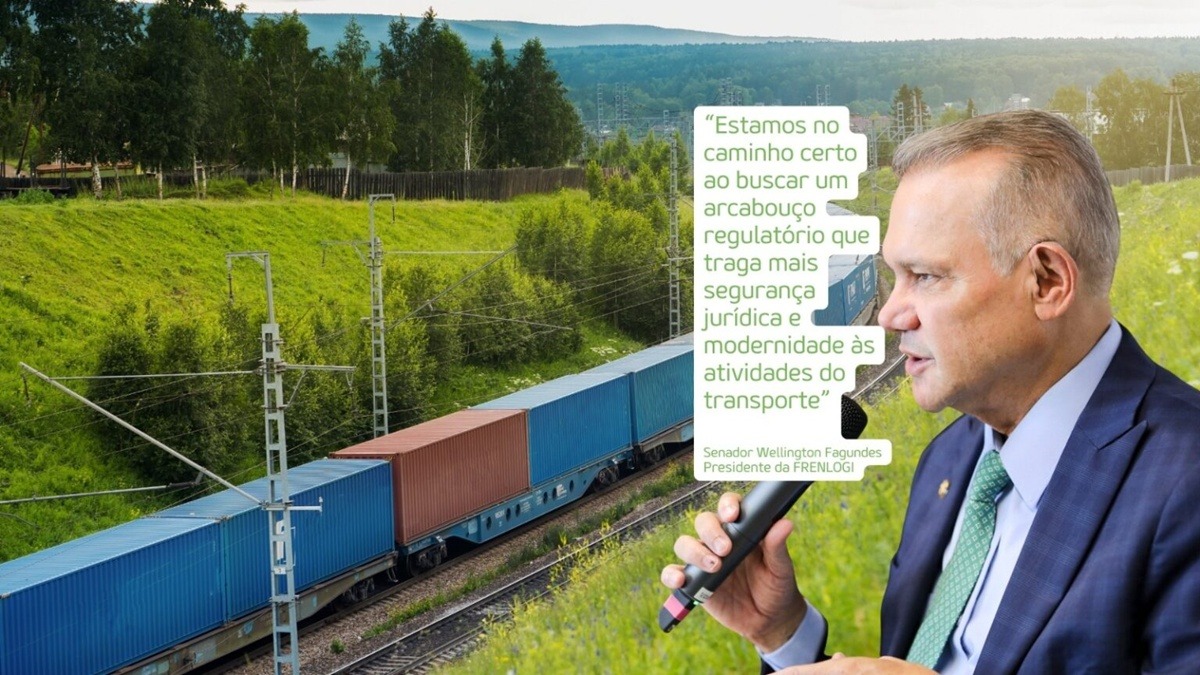
The president of the Mixed Parliamentary Front for Logistics and Infrastructure (FRENLOGI) and pre-candidate for the governorship of MT, senator Wellington Fagundes (PL-MT), highlighted that the performance reflects important advances in the regulatory environment and in attracting investments to the sector.
"The data on increased volume of cargo transported by the rail sector over the past three years, released by the Ministry of Transportation, indicates that we are on the right track in seeking a regulatory framework that brings greater legal certainty and modernity to transport activities," he stated.
The president noted that two legal milestones were decisive in driving rail investments in the country.
"In previous administrations we managed to pass two important milestones for the sector: Law No. 13,448/2017, which addresses the early renewal of rail contracts, and Law No. 14,273/2021, the new legal framework for railways, which established the authorization-based concession model. In Mato Grosso, these measures enabled major projects, such as the extension of Ferronorte from Rondonópolis to Primavera do Leste, Dom Aquino, Cuiabá and Lucas do Rio Verde, in addition to the construction of the Centro-Oeste Integration Railway (FICO), connecting Mara Rosa, in Goiás, to Água Boa, in Mato Grosso," he highlighted.
According to Fagundes, encouraging infrastructure investments and strengthening legal certainty is a central part of the parliamentary front's work.
"Promoting investments, expanding legal certainty and encouraging the expansion of logistics infrastructure is a fundamental role of FRENLOGI," he said.
The FRENLOGI president also warned that international tensions, the war between the USA/Israel against Iran, could generate impacts on the logistics chain and transport costs.
"At this moment of international tensions, we could see an escalation in fuel and fertilizer prices, with significant impacts on agribusiness contracts and the Brazilian logistics chain, especially on freight costs and food prices. Logistics is a state policy, logistics is an agricultural policy and logistics is an economic policy. We need to unite in a major national effort to expand infrastructure supply across all transport modes," he declared.


On the Ministry's data, Davi Barreto, advisor to the Brazil Logistics Institute (IBL) and president-director of the National Association of Rail Transporters (ANTF), stated that the record in rail movement demonstrates the consolidation of the mode as a strategic axis of Brazilian logistics.
"The new record confirms the growing relevance of rail transport to Brazil's entire cargo logistics. This historic milestone reflects operational gains, increased demand for exports and, above all, a consistent cycle of private investment in the sector. The more than 555 million tons transported show the maturation of railways as a structuring axis of more efficient and sustainable logistics," he stated.
The Ministry of Transportation attributes the result to the advancement of policies aimed at expanding the national logistics network. The forecast is R$ 140 billion in investments in the rail sector by 2026, with the execution of eight auctions by the end of the year. The ministry's estimate is that, over the coming years, the total volume of investments in the mode will reach approximately R$ 600 billion.
According to the government, the strengthening of land transport chains seeks to increase efficiency in the flow of national production. An example is the transport of grains produced in Mato Grosso, the country's leading producing state, which can travel by rail to the Southeast and to ports in the region, reducing truck traffic on highways and contributing to the reduction of greenhouse gas emissions.
A survey by Infra S.A. on rail movement in 2025 shows that the agricultural sector recorded the highest growth, with an increase of 4.62%. Following are other commodities, with an advance of 3.43%.
Iron ore remains the main product transported, with 401.35 million useful tons, a volume 2.72% higher than that recorded in 2024.
Currently, Brazil has 14 rail concessions in operation. According to the Ministry of Transportation, one of the priorities has been to reorganize the sector's project portfolio to ensure greater effectiveness in the execution of initiatives.
```