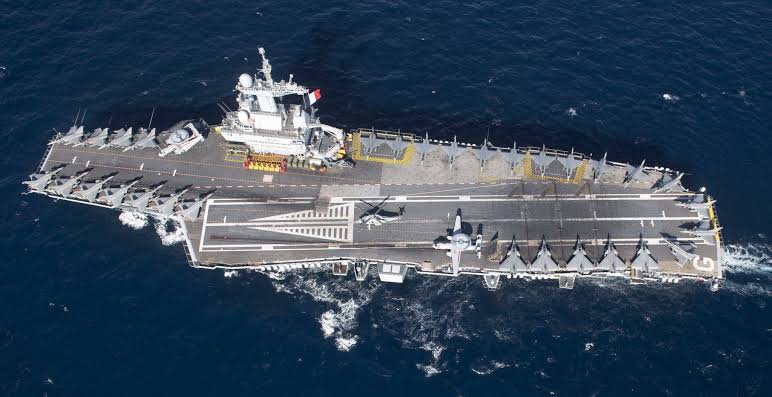

A fitness tracking record logged on a running app inadvertently exposed the near real-time location of the French aircraft carrier Charles de Gaulle, a case that has raised serious questions anew about operational security in the current military context.
The disclosure of data associated with a training exercise conducted aboard revealed the ship's position in the eastern Mediterranean, clearly demonstrating how careless use of digital tools can compromise military assets of high strategic importance. The incident gained prominence after it was reported that a French military officer had used a sports application during a run conducted aboard the aircraft carrier itself. The information shared publicly made it possible to reconstruct the route and link it to the ship's flight deck, enabling the Charles de Gaulle to be located with a degree of precision that, under normal circumstances, should have been far beyond public reach. In a sensitive regional theater, where the presence of major naval units carries political, military, and symbolic weight, a breach of this kind cannot be treated as a mere individual lapse. The case shows that in today's technological environment, the exposure of positions at sea no longer depends solely on satellites, radars, or classical surveillance means. A smartwatch, a smartphone, or an apparently trivial application can become unintentional sources of sensitive information.
More than an isolated incident, this episode serves as a warning to navies and armed forces in general. Digital discipline has now become part of military security itself. In an age when virtually everything can be recorded, shared, and cross-referenced with other open sources, a single routine and seemingly harmless gesture is enough to create a vulnerability with strategic reach. At sea, where position is power, revealing too much can be a mistake with consequences far more serious than appears at first glance.


This publication was generated from information in the original feed. Credits and source reference have been included at the end of the text.
Source: https://portaldomar.org/2026/03/20/aplicacao-de-corrida-expos-localizacao-de-porta-avioes-frances-no-mediterraneo/ ```