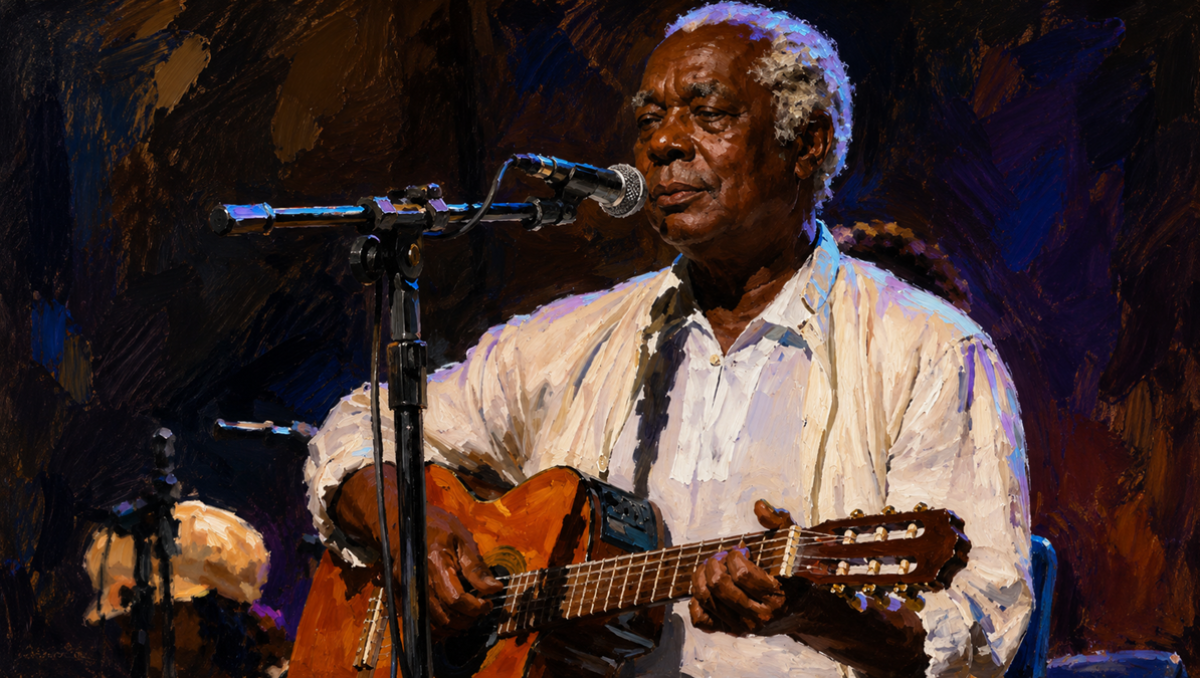
While searching for music to listen to, I came across a beautiful recording of "Filho de Rei", by Mateus Aleluia, a Brazilian singer, composer, guitarist and researcher whose work occupies a singular place in Afro-Brazilian music.
Between the guitar and percussion, there emerged a chant in Yoruba that, at first, sounded like a mysterious whisper. That experience made me reflect on our relentless pursuit of new languages. We study English, Spanish and so many other languages, and that is wonderful. I myself have walked that path. What is curious is that it rarely occurs to us to turn our ears to the languages that helped shape Brazilian culture and which, though present in our music, religiosity and everyday vocabulary, remain absent from our collective memory.
There is an irony worth noting. We seek the perfect accent for international meetings, while we ignore the sounds that crossed the Atlantic and flourished on Brazilian soil.
It is not about exchanging one language for another, nor about rejecting global learning. It is about broadening our horizons: recognizing that learning can also be an act of historical reconciliation. Perhaps true cultural sophistication lies not only in speaking English flawlessly, but in acknowledging that our linguistic heritage is vaster than we imagine.
After all, what kind of country is this that knows the irregular verbs of another nation, but barely recognizes the words of its own anthem, or words that cradled the faith, resistance and art of its own ancestors? The discomfort of that question may be precisely the invitation we need to keep learning—this time, also looking backward.


by: Luiz C Oliveira
Mateus Aleluia | Filho de Rei -
"Filho de Rei" - Mateus Aleluia is sung in Portuguese, but has parts in Yoruba, which is a language of African origin.
```